Last updated: July 1, 2026
You’ve decided to cut the cable and switch to streaming TV — now comes the awkward part: handing money to a provider you found on a search results page. The phrase buy IPTV subscription brings up thousands of sites in 2025, and the gap between the reputable ones and the throwaway-domain ones is wider than most buyers realize. This guide walks you through how to pay safely, what to verify before checkout, and which providers are worth your card details this year.
On this page
- Why buy an IPTV subscription instead of staying with cable?
- 5 things to verify before you buy an IPTV subscription
- Payment methods accepted by reputable IPTV services
- IPTV box subscription vs IPTV app subscription — the difference
- IPTV pay per view — when it actually makes sense
- Money-back guarantees and refund clauses to demand
- Top 5 places to buy IPTV subscription 2025
- What to do after you buy: the activation flow
- FAQ: buy IPTV subscription 2025
- The bottom line
We’ve checked refund policies, payment support, and post-purchase activation flow on the top providers serving English-speaking buyers. Most of the noise on Google is from short-lived resellers; the handful that survive year-over-year all share three traits we’ll cover below.

Why buy an IPTV subscription instead of staying with cable?
The math is the easy part. A US cable bundle averages $83/month in 2025 once you add the box rental, DVR fee, and regional sports surcharge. A reputable IPTV subscription with the same channel breadth costs $12–$20/month, or roughly $90–$150 for a full year. That’s a 70–85% saving, and you get something cable can’t offer: portability. Your IPTV sub follows you to a laptop, phone, Fire TV stick, Android box, or smart TV — no physical receiver, no installer appointment, no two-year contract.
The other reason people switch is content depth. An IPTV box subscription typically carries 15,000+ live channels across regions, plus a VOD library closer in size to Netflix + Hulu combined than to any cable package.
5 things to verify before you buy an IPTV subscription
Spend ten minutes on these checks and you’ll filter out 90% of the scammy listings on Google. We’ve watched dozens of providers come and go; the patterns repeat.
- Look for a refund window in writing. A real business publishes a refund policy on a dedicated page, not buried in a footer line. The standard in 2025 is 7-day or 14-day money-back, no questions asked. If the only refund language is “all sales final” or there’s no policy page at all, walk away.
- Check the payment processor. Reputable IPTV services accept Visa, Mastercard, or American Express through a real processor (Stripe, PayPal, Square). If a provider only accepts cryptocurrency or wire transfer, that’s a five-alarm fire — those payments aren’t reversible, and that’s exactly why scammers prefer them.
- Confirm the free trial actually works. A 24- or 48-hour free trial costs the provider almost nothing and proves their stream works on your devices. Providers who refuse to offer one are usually hiding bitrate, buffer issues, or channel-count exaggeration. Try the Ottocean free trial as a reference for what a real one looks like.
- Verify the domain age. Use a WHOIS lookup. If the site was registered three weeks ago, it’s either a brand-new reseller or a recycled scam domain. Established providers have 2+ years of WHOIS history and a consistent business address.
- Test the support response. Email the support address before you buy. Ask a basic pre-sale question. If you don’t get a human reply within 24 hours, that’s how long every future support ticket will take too.
That checklist is the single biggest filter between a working IPTV sub and a Smarters app throwing 401 errors. For a deeper look at one provider that passes all five, see our Ottocean IPTV review.
Payment methods accepted by reputable IPTV services
The payment menu tells you a lot about a provider’s seriousness. A real business has multiple options because customers come from everywhere; a fly-by-night reseller has one because that’s the only processor that hasn’t banned them yet.
- Visa / Mastercard / Amex via Stripe. The gold standard. Card payments are reversible via chargeback if the service fails, which is your strongest consumer protection.
- PayPal. Excellent fallback. PayPal’s buyer protection covers digital goods on a 180-day window, so if the service goes dark you can usually claw the money back.
- SEPA bank transfer. Common with EU-facing providers. Slower (1–3 days to clear), but legitimate. Should always sit alongside card options, never as the only choice.
- Cryptocurrency (BTC, USDT, ETH). Acceptable as an option for privacy-conscious buyers. Concerning as the only option — that almost always means the provider has been kicked off card processors.
- Apple Pay / Google Pay. Increasingly common as a checkout convenience. Same protection as the underlying card.
For the academic version of why recurring revenue works only when customers stay, Wikipedia’s subscription business model overview covers the economics. That’s why honest IPTV providers are happy to offer trials and refunds — the math works in their favor when the product is real.
IPTV box subscription vs IPTV app subscription — the difference
This trips up first-time buyers constantly. The two phrases get used interchangeably, but they’re not the same purchase.
An IPTV box subscription usually means you bought a small Android-based set-top box and the seller pre-loaded their service onto it. One fee covers both hardware and streaming. Upside: plug-and-play. Downside: if the seller disappears, your box becomes a paperweight because the firmware is locked to their server.
An IPTV app subscription means you pay for credentials (username, password, server URL) and load them into a generic player like IPTV Smarters Pro or TiviMate on hardware you already own. Upside: portable and future-proof. Downside: 60 seconds of one-time setup.
For 2025, we recommend the app route. Your hardware is yours, your credentials are yours, and if you switch providers you just paste new credentials. That’s the model the main Ottocean IPTV subscription uses by default.
IPTV pay per view — when it actually makes sense
Most people don’t need IPTV pay per view in 2025 — a monthly sub costs less than a single PPV boxing event. But two niches make PPV worthwhile:
- One-off mega events. A heavyweight title fight or UFC numbered card sometimes airs only on a PPV partner. A one-night pass beats upgrading your plan.
- Travel. If you’re abroad for two weeks and just want one game, PPV beats committing to a monthly sub.
Reputable services offer PPV as an add-on rather than the core product. A site selling only PPV passes is usually a one-event scrape, not a real business.
Money-back guarantees and refund clauses to demand
Refund language is where providers separate themselves. Here’s what a buyer-friendly clause looks like in 2025:
- 7-day or 14-day money-back, no reason required. You email support, they refund. Period.
- Pro-rata refund for service outages. If the server is down for more than 24 hours, you get credit or a partial refund without having to argue.
- Refund processed within 5–10 business days. Card refunds take that long to land — anything faster is suspicious, anything longer than 14 days is stalling.
- Refund to original payment method. Not “store credit,” not “next renewal discount.”
If a provider’s refund page is missing, vague, or contradicted by social-media complaints from real customers, don’t buy. There are enough honest IPTV subs on the market that you don’t need to gamble on this.
Top 5 places to buy IPTV subscription 2025
1. Ottocean
Our top pick for 2025 and the only one we’d hand a first-time buyer without caveats. 18,000+ channels, real 4K tier, Stripe + PayPal + crypto on the payment page, 7-day money-back, and a 24-hour free trial. US, EU, and UK server clusters keep first-frame under 100 ms in either continent. Plans start at $14.99/month with steep annual discounts.
2. IPTVTrends
Long-running provider with a clean refund policy and PayPal support. Channel count is slightly smaller than Ottocean but stable. Good fallback if you want a US-focused lineup.
3. Iconic Streams
UK-leaning catalog, especially strong on Premier League and Sky Sports content. Card and PayPal accepted. Slightly clunkier signup flow but legitimate.
4. Apollo Group TV
Long-term player with a generous channel list and 4K tier. Shorter refund window (5 days) — test the trial carefully.
5. Honey Bee TV
Budget option with smaller VOD library but reliable live TV. Pick if cost matters and you don’t need 4K.
Note we’re calling this “IPTV sub” rankings rather than just “channel-count rankings” — the order reflects the full buyer experience, not the marketing page. You can compare all five side by side in our extended Ottocean IPTV review, which benchmarks them on the same network, devices, and 30-minute soak tests.
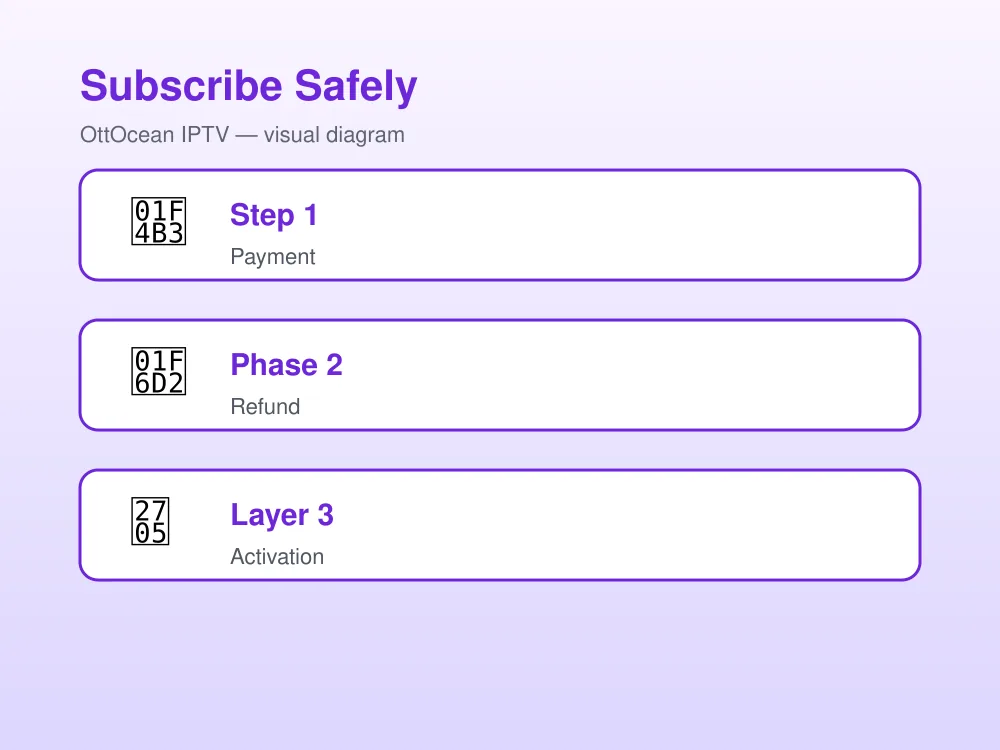
What to do after you buy: the activation flow
Once payment clears on a real IPTV subscription 2025, the activation should land in your inbox within 5–15 minutes. Here’s the standard flow so you know what to expect:
- Receipt email. Sent immediately by the payment processor (Stripe, PayPal). This is just the receipt, not the credentials.
- Credentials email. Sent by the provider within minutes. Contains a server URL, username, password, and an M3U playlist URL. Save this email — you’ll need it again when you reinstall the app.
- Install your player. On Firestick: install IPTV Smarters Pro via Downloader. On Apple TV: TiviMate or GSE Smart IPTV from the App Store. On Android TV: any of the above from the Play Store.
- Enter your credentials. Pick “Xtream Codes API” login (recommended), paste the three fields, save.
- Channel list loads. Should take 10–60 seconds depending on the size of the EPG. Pick a channel, hit OK, and confirm you have a picture.
If the picture is missing or you get an authorization error, that’s almost always either a wrong-credential paste or a one-time server reload. Email support; a real provider will fix it within an hour. If the support reply doesn’t arrive that day, use your refund window — you bought it for exactly this reason.
FAQ: buy IPTV subscription 2025
Is it legal to buy an IPTV subscription?
Buying a subscription from a provider that licenses or owns its content is fully legal. The legality depends on the provider, not on you as the buyer. Stick to services that publish their licensing model and operate openly.
How much should I pay for an IPTV sub in 2025?
Reputable providers charge $12–$20/month, or $90–$150 for a full year. Anything under $5/month is usually a reseller of resellers — the stream is unstable and the provider rarely survives 12 months.
Can I get a refund if my IPTV box subscription doesn’t work?
Yes, if the provider has a published refund policy and you’re inside the window. That’s why the 5-step pre-purchase checklist above matters — buy from someone who actually offers a refund route.
Is buy IPTV subscribe safer with PayPal than card?
Both are safe with reputable providers. PayPal has a longer dispute window (180 days) than most card chargebacks, but card chargebacks tend to resolve faster. Use whichever your card issuer protects best.
What’s the difference between an IPTV sub and an IPTV reseller plan?
A regular IPTV subscription is one user account for personal use. A reseller plan gives you credits to issue sub-accounts to other end users — basically a small business package. Don’t buy a reseller plan unless you actually plan to resell, since it costs significantly more per user.
The bottom line
Buying an IPTV subscription in 2025 is straightforward once you know what to verify. Demand a refund policy in writing, pay through a real processor (Visa, Mastercard, or PayPal — not crypto-only), test a free trial first, and confirm support actually responds. Providers that pass all four checks are rare but they exist, and once you find one, your monthly TV bill drops by 80% without losing channels. Start with the Ottocean free trial — credentials land in minutes, the 7-day refund window covers you, and you’ll know within an evening whether it’s the IPTV sub worth keeping for the year.