Last updated: June 22, 2026
If you’re new to IPTV, the technology behind it is genuinely simple — but the marketing around it is so muddled that the basics rarely come through. This plain-English guide explains how IPTV works in 2026: from the camera at a stadium to the picture on your TV, what changes when “live” goes through the internet, and why the engineering choices behind a service decide whether you’ll love it or curse it.
On this page
- How IPTV works: the four-layer model
- The protocols that make IPTV work
- What “live” really means in IPTV
- How IPTV works differently from cable
- How an IPTV service is engineered
- What can go wrong in the chain
- How IPTV works on different devices
- Why IPTV is the future of TV — and where it isn’t
- The bottom line
- FAQ: how IPTV works
No jargon-as-drama, no marketing fluff. By the end you’ll know exactly what to ask a provider before you pay, and why some “IPTV services” struggle with the same Sunday-night load that others handle without breaking a sweat.

How IPTV works: the four-layer model
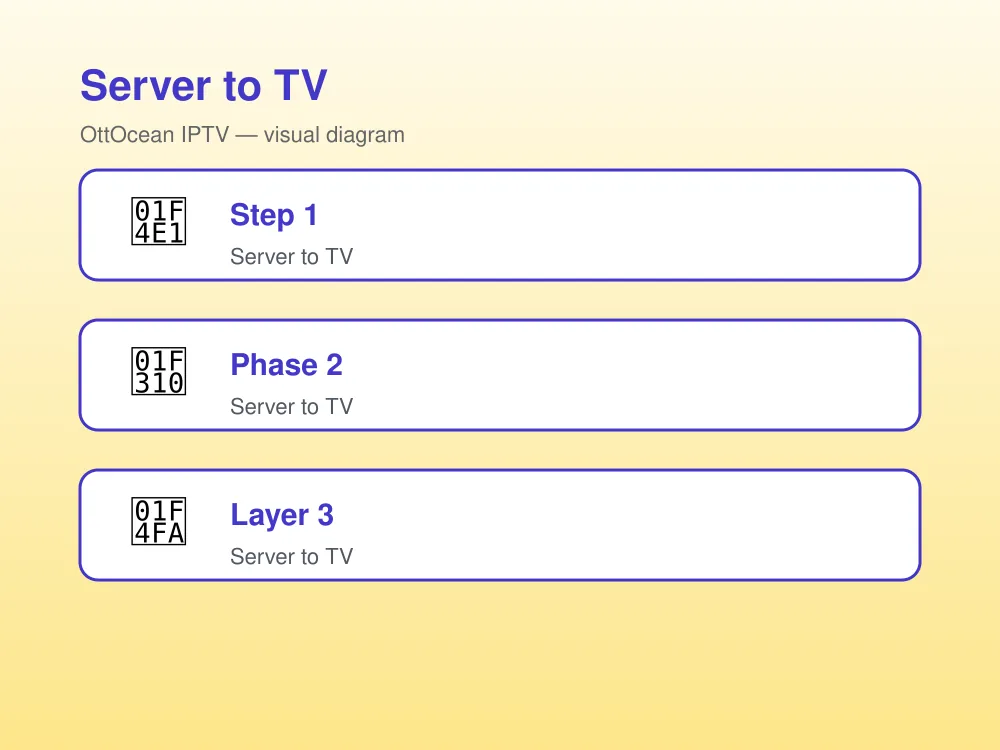
Every IPTV system, from a cable company’s mobile app to an independent provider, follows the same four-layer pattern:
Layer 1 — The source
A camera, a satellite feed, or a studio output. This is the raw broadcast — same source that feeds traditional cable.
Layer 2 — Encoding
The source video is compressed into modern codecs (HEVC, H.264, or AV1) and chopped into small chunks (typically 2–6 seconds each). Each chunk is independently decodable. This is how the player can “join in progress” without rewinding.
Layer 3 — Distribution (CDN)
Chunks are uploaded to a content delivery network — a global mesh of servers that hold copies of the same content close to viewers. When you press play, your player asks the nearest CDN node, not the original encoder.
Layer 4 — Playback
Your IPTV player app (Smarters Pro, TiviMate, SS IPTV, etc.) downloads chunks one at a time, decodes them, and shows the picture. It also maintains a small buffer — usually 5–15 seconds — so a brief network hiccup doesn’t cause a visible stutter.
That’s it. Everything else is detail.
The protocols that make IPTV work
Three terms come up if you read into the technical side:
- HLS (HTTP Live Streaming). Apple’s standard. Each chunk is a small
.tsfile; a playlist (.m3u8) tells the player which chunks to fetch in order. - MPEG-DASH. The open-standard equivalent. Slightly more flexible, used by Netflix and YouTube.
- RTMP. Older protocol, used by some camera-to-encoder pipelines. Rarely user-facing now.
Both HLS and DASH let the player switch bitrates on the fly — if your Wi-Fi drops, the player automatically grabs a lower-bitrate chunk instead of buffering. That’s called adaptive bitrate streaming, and it’s why modern IPTV doesn’t pause as often as 2010-era streams did.
What “live” really means in IPTV
True real-time TV doesn’t exist over the internet — there’s always a few seconds of latency built into the chunk-and-buffer model. Realistic numbers in 2026:
- Traditional cable / satellite: 1–3 seconds behind real time.
- Low-latency HLS (LL-HLS): 3–5 seconds behind. Used by quality IPTV services for sports.
- Standard HLS / DASH: 8–15 seconds behind. The default for most IPTV.
- Cheap IPTV servers: 20–45 seconds behind. Noticeable during live sports — neighbors will cheer before your TV shows the goal.
If you watch a lot of live sports with friends on phones, look for a provider that runs LL-HLS or has documented sub-10-second latency. Our IPTV sports streaming guide covers what to test.
How IPTV works differently from cable
Two architectural differences explain almost every IPTV advantage and quirk:
1. The network is the delivery system
Cable runs a single coaxial line into your home that always broadcasts all channels — your box just tunes one at a time. IPTV uses your existing internet line and only sends the channel you’re currently watching. This is why IPTV doesn’t need a special line installed and works the same on Wi-Fi as Ethernet.
2. The player is the box
Cable boxes are dedicated single-purpose hardware. IPTV “boxes” are general-purpose computers running an app — your Firestick, Shield, Smart TV, phone, or laptop. That’s why one IPTV subscription works on any device with the player app installed.
How an IPTV service is engineered
From the inside, a quality IPTV provider’s stack looks like:
- Source acquisition. Licensed feeds from broadcasters or aggregators.
- Origin encoder. Re-encodes each feed into multiple bitrate ladders (e.g., 480p / 720p / 1080p / 4K) so the player can adapt.
- EPG service. Generates the XMLTV electronic program guide file your player reads.
- Authentication API. Validates your Xtream Codes credentials and authorizes playback.
- CDN edge. Hundreds of servers globally, holding cached chunks close to viewers.
- Monitoring. Watches for buffer events, server load, and stream dropouts in real time.
The quality difference between providers is mostly here — not in the channel count.
What can go wrong in the chain
Knowing how IPTV works helps you debug when something fails. The most common failure points:
- Your Wi-Fi. 80% of “IPTV problems” are 2.4 GHz Wi-Fi too far from the TV. Move closer, use 5 GHz, or run Ethernet.
- Your player engine. Native player isn’t using hardware decode. Switch to ExoPlayer.
- The provider’s origin encoder. Rare but visible — if all channels stutter at once, the encoder is overloaded.
- The CDN edge. A single bad node can cause one user to buffer while everyone else is fine. Quality providers route around bad nodes automatically.
- The authentication server. “Failed to authorize” errors trace here. Our authorize fix guide walks through the diagnostic.
How IPTV works on different devices
The hardware on your TV does a lot more work than you might think. Specifically:
- Demuxing — splitting audio and video streams from each chunk.
- Decoding — HEVC/AV1 decode, ideally in hardware.
- Rendering — sending decoded frames to the TV at the right frame rate.
- Buffer management — keeping enough chunks ready that small network gaps don’t show.
A modern Firestick 4K Max or NVIDIA Shield does all of these in dedicated silicon. Older smart TVs may software-decode, which is why a $40 streaming stick often outperforms a $1,500 6-year-old TV on the same network.
Why IPTV is the future of TV — and where it isn’t
Honest assessment in 2026:
- IPTV is now the dominant delivery model for new services. Every “live TV” launch since 2022 (YouTube TV, Fubo, Sling expansions) is IPTV under the hood.
- Cable companies are migrating their own customers to IPTV. The set-top boxes themselves are being replaced with streaming apps.
- Where it isn’t winning: ultra-low-latency live (in-stadium replay, financial market feeds), where the buffer model is a hard limit.
For most consumer use cases — live TV, sports, news, on-demand — IPTV is now the default. The question is which provider to subscribe to, not whether to use IPTV at all. See the streaming media reference for the broader context.
The bottom line
That’s how IPTV works: encode, chunk, distribute, play — four layers, modern codecs, adaptive bitrate. The quality difference between providers lives in encoder bitrates, CDN footprint, and EPG accuracy, not in the technology itself. To experience a quality stack on your own hardware, the OttOcean free trial ships credentials in minutes. For more on what to look for next, see our best IPTV 2026 roundup.
FAQ: how IPTV works
How does IPTV work without a cable box?
The IPTV player app on your Firestick, Smart TV, or phone replaces the cable box. It downloads stream chunks over your internet connection instead of receiving coax broadcasts.
How fast does my internet need to be for IPTV?
25 Mbps clean to the device handles 1080p comfortably. 35–50 Mbps handles 4K. Wi-Fi quality matters more than headline ISP speed.
How does IPTV work over Wi-Fi vs Ethernet?
Identical at the application layer. Ethernet is more stable; Wi-Fi 6/6E on a close router is nearly as good. 2.4 GHz Wi-Fi is the only true limiter.
How does IPTV know which channels I can watch?
Your Xtream Codes credentials or M3U URL authenticate against the provider’s server, which sends back the channel list your subscription is entitled to.
Is IPTV technology different from Netflix?
Same underlying tech (HLS/DASH, modern codecs, CDNs). The differences are content licensing and the user-facing app design.