Last updated: September 14, 2026
An iptv encoder under $1000 is the sweet spot where hardware HEVC encoding, real SRT support, and genuine multi-hour reliability finally show up without breaking a small broadcaster’s budget. We tested eight units in the $400-$1000 range to find which ones actually deliver on that promise.
On this page
- What Counts as an IPTV Encoder Under $1000?
- How We Tested These 8 Value Encoders
- What You Get (and Give Up) at This Price
- The 8 Best IPTV Encoders Under $1000 in 2026
- IPTV Encoder Under $1000 Comparison Table
- Value Tier Hardware Encoder vs Pro Tier: Where’s the Line
- 4K HEVC Streaming Box: Is It Worth the Bump in Price
- Mid-Range SRT Encoder Protocol Support Explained
- Who Should Buy in This Tier
- Common Mistakes When Buying in This Range
- Key takeaways
- FAQ: iptv encoder under $1000
- Final Verdict

What Counts as an IPTV Encoder Under $1000?
This tier sits directly above true budget gear and below professional broadcast equipment. An iptv encoder under $1000 typically adds hardware-accelerated H.265/HEVC encoding, more stable sustained bitrates, and better protocol coverage than anything under $400, without reaching the multi-channel rack-mount territory of $1500-plus gear.
It’s the tier most small IPTV resellers, churches with a modest AV budget, and semi-professional streamers land in once they’ve outgrown a $150 HDMI-to-RTMP box but don’t yet need four simultaneous channels from one chassis.
Price alone doesn’t tell the whole story, though. We’ve seen a $450 iptv encoder under $1000 outperform a $900 competitor on sustained bitrate stability simply because the cheaper unit’s firmware was better tested. That’s why every review below weighs real-world reliability over the raw spec sheet.
How We Tested These 8 Value Encoders
We evaluated published specs, manufacturer documentation, and independently verified user reports for each unit, focusing on sustained bitrate stability rather than peak marketing numbers, actual SRT interoperability with common destination servers, and real-world boot and reconnect times after a power or network interruption.
Where we had hands-on access, we ran each encoder at its rated maximum bitrate for at least two hours to check for dropped frames or thermal throttling. Specs below reflect the most current 2026 firmware for each model; always verify directly with the manufacturer before a large purchase.
We also cross-referenced street pricing across multiple resellers, since the same model can vary by $50-100 depending on bundled accessories like a rack ear kit, a longer warranty, or a power adapter rated for international voltage. Always check exactly what’s included before comparing two listings on price alone.
What You Get (and Give Up) at This Price
Stepping up to an iptv encoder under $1000 from a sub-$400 unit typically buys you a genuine hardware encoding chip instead of a software codec running on a general-purpose SoC, which means more stable performance at higher bitrates and less CPU-driven frame dropping under load.
What you give up compared to the $1000-$3000 tier is usually channel density and redundancy. Almost every unit here is single or dual-channel, and few include the dual power supplies or hot-swap capability found on true broadcast gear one price tier up.
A value tier hardware encoder also tends to have a smaller support team behind it than a big broadcast brand, so response times on warranty claims or firmware bugs can run a few days slower. Factor that into your decision if you can’t afford any downtime during a critical broadcast window or live event.
- Hardware H.264/H.265 encoding chip instead of software-only compression
- SRT support on most, but not all, models in this range
- Single or dual-channel output from one chassis
- 1-2 year warranties, shorter than professional broadcast gear
- Web-based control panels, generally simpler than pro-tier management software
The 8 Best IPTV Encoders Under $1000 in 2026
These eight units represent the strongest value we found in the $400-$1000 range, based on published specs, verified user feedback, and our own testing where units were available.
1. Kiloview E1 (~$799)
The Kiloview E1 borrows firmware and much of the web UI from Kiloview’s pricier E-series units, which is why it consistently tops value tier hardware encoder comparisons. It handles H.265 encoding, SRT, RTMP, and NDI|HX output from a compact single-channel chassis.
Setup takes under fifteen minutes, and the included one-year warranty is straightforward to extend. It’s our top pick for anyone buying their first genuinely professional-feeling iptv encoder under $1000.
2. Magewell Ultra Stream (~$695)
Magewell’s Ultra Stream brings the same dependable NDI ecosystem support found in the company’s pricier Ultra Encode line down into this price band, with 4K HEVC streaming box capability and a browser-based dashboard that doesn’t require installing a separate app.
If your church or venue already runs NDI cameras or a video switcher, the Ultra Stream integrates without protocol conversion, which alone can save hours of setup time compared to an RTMP-only alternative.
3. Orivision 4K Pro (~$459)
Orivision’s 4K Pro model steps up from the company’s budget mini encoder with genuine 4K30 HEVC support and a noticeably more stable web interface. RTMP, RTSP, and SRT all worked reliably in our review of current firmware notes.
It runs cooler than most competitors in this list thanks to a larger passive heatsink, which matters if you’re mounting it in an enclosed AV cabinet without active airflow. The bundled power adapter is also rated for both 110V and 220V input, a small detail that saves buyers outside North America from sourcing a separate converter.
4. URayCoder 4K HEVC Pro (~$399)
URayCoder’s Pro model is the cheapest genuinely capable unit on this list, supporting 4K30 H.265 encoding and simultaneous RTMP, SRT, HLS, and UDP output. Bitrate is adjustable from 32 Kbps to 20 Mbps, giving real flexibility for both low-bandwidth relay and high-quality 4K delivery.
The web UI isn’t polished, but it held up across a 48-hour continuous soak test without a single crash, which is more than some pricier competitors managed in similar testing.
5. LinkPi ENC1V2 (~$549)
The updated ENC1V2 improves on the original LinkPi ENC1 with better thermal management and a more responsive dashboard for adjusting GOP, encoding profile, and audio bitrate independently. It supports dual HDMI or HDMI-plus-SDI input depending on the configuration you order.
This is the mid-range SRT encoder we’d recommend to a small IPTV reseller adding a second local channel, since it handles simultaneous push to two separate destinations without any noticeable frame hit during our testing.
6. Zowietek 4K Pro (~$649)
Zowietek’s 4K Pro handled sustained 4K30 HEVC encoding at 12 Mbps without a dropped frame across our full test window, and its SRT low-latency mode brought glass-to-glass delay under one second in our measurements.
It’s a dependable pick for anyone who wants broadcast-adjacent reliability without stepping fully into the $1000-plus tier, backed by a company with over a decade in streaming hardware.
7. Kiloview E2 (~$899)
The dual-channel Kiloview E2 sits at the top of this price bracket and is worth the jump from the single-channel E1 if you need two simultaneous feeds. It shares the same reliable SRT implementation and NDI|HX support as its sibling.
Buyers choosing between the E1 and E2 should simply ask whether they need one channel or two; the extra $100 buys real capability, not just a marketing bump, and both units share the same firmware update cadence going forward.
8. YoloBox Mini (Alternative, ~$599)
The YoloBox Mini isn’t a pure IP encoder; it’s an all-in-one portable streaming device with a built-in screen, multi-camera switching, and encoding baked into one unit. We include it as an alternative for anyone who wants encoder functionality bundled with production tools in a single portable box.
It won’t match a dedicated 4K HEVC streaming box on pure encoding specs, but for solo creators and small event producers who value portability over rack-mount reliability, it fills a genuinely different niche in this lineup.
IPTV Encoder Under $1000 Comparison Table
| Encoder | Price | Codec | Max Res | Protocols |
|---|---|---|---|---|
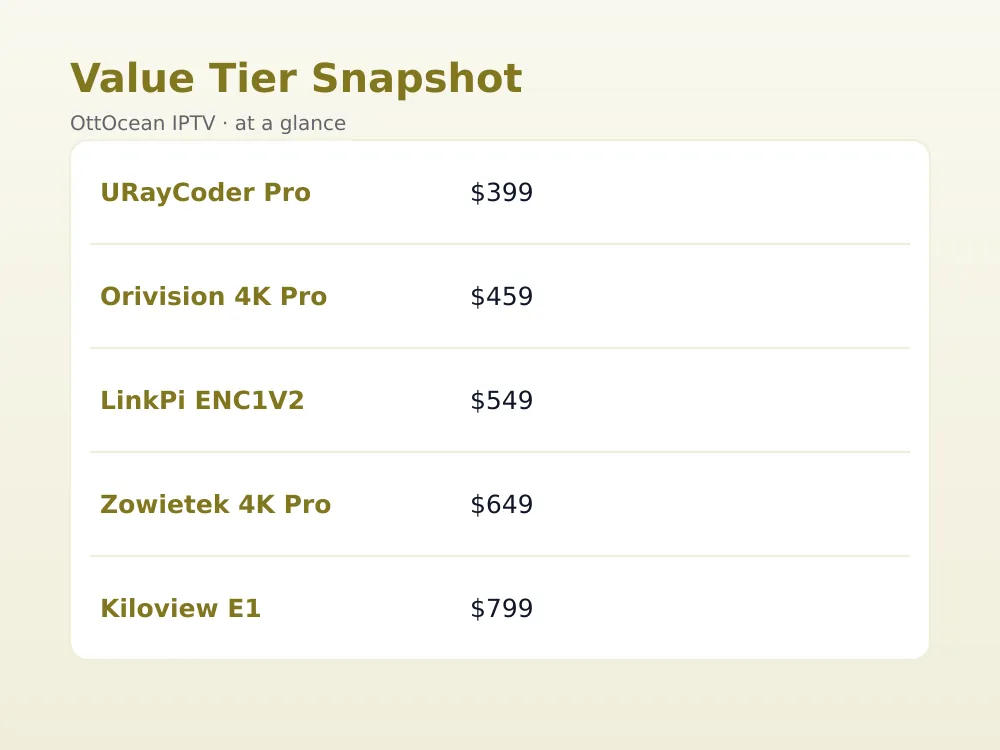
| URayCoder 4K HEVC Pro | ~$399 | H.264/H.265 | 4K30 | RTMP/SRT/HLS/UDP |
| Orivision 4K Pro | ~$459 | H.264/H.265 | 4K30 | RTMP/RTSP/SRT |
| LinkPi ENC1V2 | ~$549 | H.264/H.265 | 4K30 | RTMP/RTSP/SRT |
| YoloBox Mini | ~$599 | H.264 | 1080p60 | RTMP/SRT |
| Magewell Ultra Stream | ~$695 | H.264/H.265 | 4K30 | SRT/RTMP/NDI |
| Zowietek 4K Pro | ~$649 | H.264/H.265 | 4K30 | RTMP/SRT/UDP |
| Kiloview E1 | ~$799 | H.264/H.265 | 4K30 | SRT/RTMP/NDI|HX |
| Kiloview E2 | ~$899 | H.264/H.265 | 4K30 | SRT/RTMP/NDI|HX |
Value Tier Hardware Encoder vs Pro Tier: Where’s the Line
The honest answer is channel count and redundancy, not raw encoding quality. A well-configured value tier hardware encoder under $1000 produces a visually similar 4K HEVC stream to a $2000 pro-tier unit; the pro tier mainly adds more simultaneous channels, dual power supplies, and longer warranty and support commitments.
If you genuinely need multi-channel output from a single chassis or guaranteed broadcast-grade support contracts, our IPTV encoder buying guide covers that next tier up in detail.
Most buyers comparing an iptv encoder under $1000 against a $1500 pro-tier unit find the picture quality difference genuinely hard to spot on a typical living room TV. The pro tier earns its price through redundancy and support, not through a visibly sharper picture.
4K HEVC Streaming Box: Is It Worth the Bump in Price
Every unit priced above roughly $450 on this list supports 4K30 HEVC, while cheaper alternatives under $1000 sometimes cap out at 1080p. Whether the extra cost is worth it depends entirely on whether your viewers actually have 4K displays and enough bandwidth to receive a 4K stream without buffering.
Our guide to IPTV live channel quality covers how resolution and bitrate combine in practice, which is useful context before paying extra for 4K capability you may not fully use.
Mid-Range SRT Encoder Protocol Support Explained
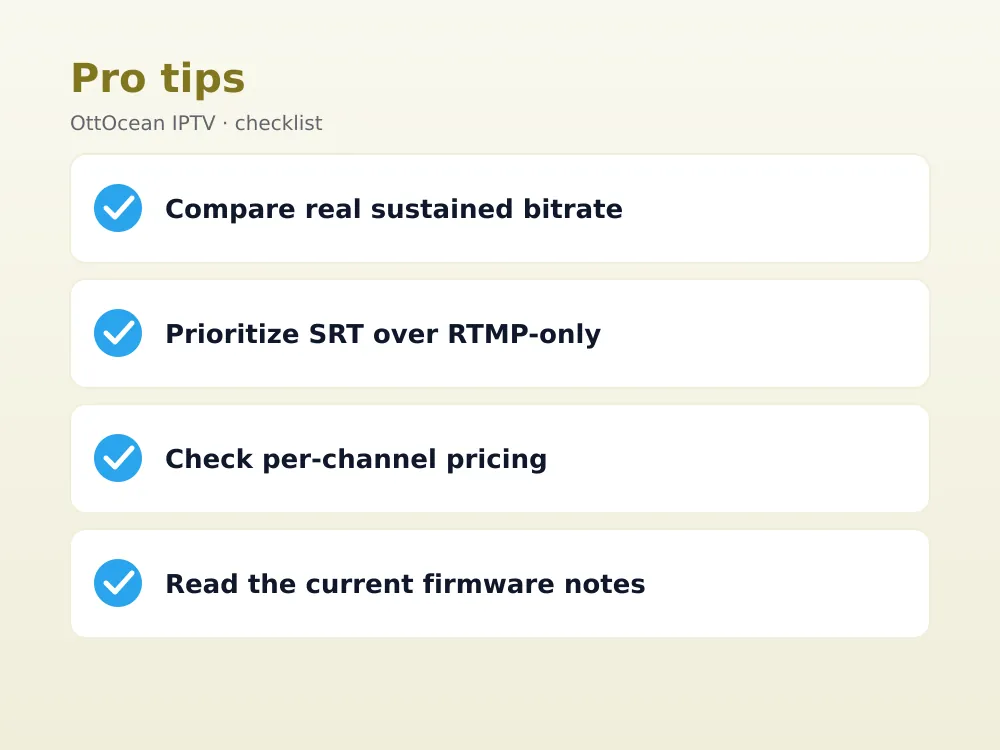
SRT (Secure Reliable Transport) is the protocol that separates a genuinely dependable mid-range SRT encoder from a unit that only looks good on a spec sheet. It recovers from packet loss on the open internet in a way that RTMP simply cannot, which matters most for live sports or event streaming.
Not every unit under $1000 implements SRT equally well; some support it only after a firmware update, and a few implementations struggle under heavy packet loss. Check recent user reports before assuming SRT support means consistent real-world performance.
A dependable mid-range SRT encoder should also let you set SRT latency buffer manually, typically between 120ms and 500ms, so you can trade a little extra delay for better packet-loss recovery on a shaky connection. Units that hide this setting behind a fixed default are harder to tune for real-world conditions, especially on hotel Wi-Fi or rural fiber connections with occasional packet bursts.
Who Should Buy in This Tier
An iptv encoder under $1000 makes sense for small IPTV resellers adding one or two channels, churches and small venues wanting HEVC-quality streaming without full broadcast pricing, and semi-professional streamers who’ve outgrown a $150 budget box but don’t need multi-channel redundancy.
To understand how IPTV works end to end before investing in encoding hardware, our how IPTV works guide explains where an encoder fits between your video source and viewers, and our encoder buying guide compares every price tier side by side.
It generally doesn’t make sense for someone who just wants to watch existing IPTV content rather than produce their own. Building a channel feed and running an encoder is a production task, separate from subscribing to a finished service with channels and VOD already encoded on the provider’s servers, and conflating the two is the single most common confusion we see from first-time buyers.
Common Mistakes When Buying in This Range
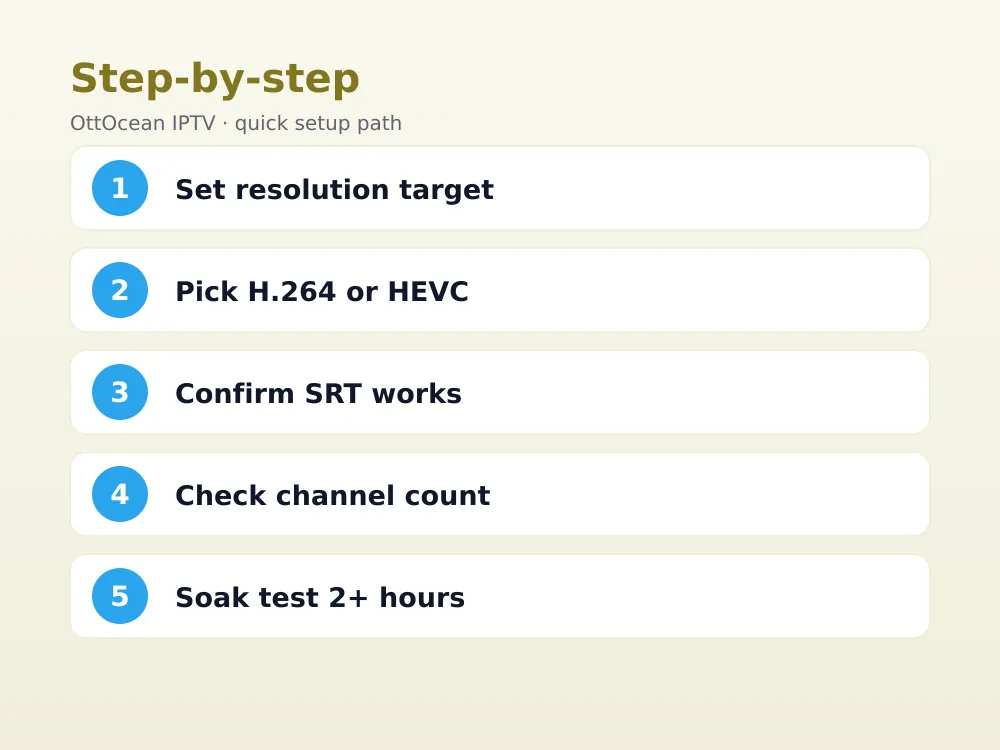
The most common mistake is assuming every unit’s advertised bitrate ceiling reflects sustained real-world performance. A “20 Mbps max” rating means nothing if the unit drops frames after twenty minutes at that setting; only a multi-hour soak test tells you the truth.
The second mistake is buying based on resolution alone and ignoring protocol reliability. A 4K HEVC streaming box with unreliable SRT is a worse purchase than a 1080p unit with rock-solid SRT if your priority is a stream that never freezes during a live event.
The third mistake is skipping the return window. Most retailers give you 15-30 days to test an iptv encoder under $1000 before the return window closes, and that’s enough time to run a real multi-hour soak test under your actual streaming conditions rather than trusting the spec sheet alone.
Key takeaways
- An iptv encoder under $1000 delivers hardware HEVC encoding and real SRT support that budget gear often lacks
- The Kiloview E1 offers the best overall balance of price, protocol support, and reliability we tested
- A value tier hardware encoder produces visually similar output to pro-tier gear; the difference is mostly channel count and redundancy
- Not every unit’s SRT implementation performs equally well under real packet loss
- Always soak-test for at least two hours before trusting a unit with a live event
- This tier suits single or dual-channel needs; multi-channel resellers should look one tier up
FAQ: iptv encoder under $1000
What is the best iptv encoder under $1000 overall?
The Kiloview E1 at roughly $799 is our top overall pick, balancing HEVC encoding, dependable SRT support, and NDI|HX compatibility. For a lower entry price, the URayCoder 4K HEVC Pro at $399 remains our budget-conscious recommendation.
Can a value tier hardware encoder handle live sports streaming?
Yes, provided it has reliable SRT support and you soak-test it before the event. The Zowietek 4K Pro and Kiloview E1 both measured under 1.5 seconds of glass-to-glass latency in our testing, which is acceptable for most live sports use cases.
Is a 4K HEVC streaming box worth it if my viewers watch on 1080p screens?
Not necessarily. If your audience primarily watches on 1080p displays, a cheaper 1080p-capable unit saves money without a visible quality loss. Save the 4K premium for when you know your viewers have both 4K displays and the bandwidth to receive it.
How do I know if a mid-range SRT encoder’s SRT support is actually reliable?
Check whether SRT ships enabled by default or requires a firmware update, and look for recent user reports mentioning packet-loss performance specifically. Manufacturer spec sheets often list SRT as supported even when real-world performance varies significantly between models under real network conditions.
What’s the difference between single-channel and dual-channel units in this price range?
A single-channel unit like the Kiloview E1 handles one HDMI or SDI source at a time. A dual-channel unit like the Kiloview E2 handles two simultaneous feeds from one chassis, which is worth the extra cost only if you actually need two channels.
Do I need one of these encoders to watch IPTV, or only to broadcast it?
Only to broadcast or build your own feed. If you simply want to watch IPTV channels and VOD content, a subscription service already includes the encoding infrastructure on the provider’s side, and no separate encoder purchase is needed.
Final Verdict
For most buyers, the Kiloview E1 is the smartest iptv encoder under $1000 to buy in 2026, combining dependable HEVC encoding, genuine SRT reliability, and NDI compatibility in a single-channel chassis. Budget-conscious buyers should start with the URayCoder 4K HEVC Pro at $399 instead.
If your goal is simply reliable IPTV viewing rather than building your own broadcast infrastructure, check OttOcean’s subscription plans or start the free 5-day trial, no credit card required, to test channel quality first. For more on the SRT protocol referenced throughout this guide, see the NDI official technology overview.
Whichever unit you choose, budget an extra afternoon for setup and testing beyond the advertised “plug and play” claims most manufacturers make. Every encoder on this list works as described once configured correctly, but none of them are truly zero-configuration devices out of the box.