Last updated: September 16, 2026
A hotel iptv encoder is the core hardware that takes live TV channels and hotel-branded content and distributes them to every guest room over IP or coaxial cable, and picking the wrong one means either overpaying for capacity you don’t need or under-sizing a system that can’t grow with your property. We compared seven hospitality-grade options.
On this page
- What Is a Hotel IPTV Encoder?
- How We Evaluated These Hospitality Systems
- IP Multicast vs RF Modulation: Which Fits Your Property
- Sizing an Encoder to Your Room Count
- The 7 Best Hotel IPTV Encoders for Hospitality in 2026
- Hotel IPTV Encoder Comparison Table
- Middleware and Guest Experience Considerations
- Cost Per Room: What to Actually Budget
- Common Mistakes When Choosing Hospitality Encoders
- Key takeaways
- FAQ: hotel iptv encoder
- Final Verdict
What Is a Hotel IPTV Encoder?
In a hospitality context, a hotel iptv encoder takes incoming satellite, cable, or streaming channel feeds and converts them into a format that can be distributed to every guest room television, either as IP multicast over the hotel’s existing network or as modulated RF channels over coaxial cable.
Unlike a single-stream encoder used for IPTV resale or a church broadcast, hospitality gear needs to simultaneously distribute dozens of channels to hundreds of rooms with guaranteed reliability, since a guest complaint about a frozen channel becomes a real service issue, not just an inconvenience.
If you’re new to how channel encoding and distribution work in general before diving into hospitality-specific gear, our how IPTV works guide covers the underlying concepts of encoding, protocols, and delivery that apply whether you’re serving one viewer or an entire hotel.
How We Evaluated These Hospitality Systems
We reviewed manufacturer documentation, hospitality AV integrator case studies, and published deployment guides for each system, focusing on room-count scalability, IP versus RF delivery options, middleware compatibility, and total cost of ownership rather than just the headend hardware price alone.
Hospitality deployments are typically installed by AV integrators rather than in-house IT teams, so we also weighed how well-documented each system is for a third-party installer, since that affects both upfront installation cost and ongoing support quality.
We did not have hands-on access to every hotel iptv encoder platform for this roundup, since hospitality-scale deployments aren’t practical to bench-test the way a single consumer encoder is. Specs and positioning below reflect manufacturer documentation and third-party integrator case studies as of 2026.
IP Multicast vs RF Modulation: Which Fits Your Property
IP multicast for hotels distributes channels over the same network infrastructure used for guest Wi-Fi and other IT services, which is efficient if you already have solid Cat6 or fiber wiring throughout the property. It’s the direction most new hospitality builds and renovations are heading in 2026.
RF modulation over coaxial cable remains common in older properties with existing coax wiring to every room, since it avoids a costly rewiring project. The tradeoff is that RF systems are generally less flexible for adding channels or interactive features later compared to an IP-based multi-channel hotel distribution system.
A growing number of properties run a phased migration: keep the existing RF modulation running while gradually wiring new or renovated floors for IP multicast, then retire the RF headend entirely once the whole property is converted. This avoids one disruptive, all-at-once cutover across every guest room and spreads the wiring labor cost over multiple renovation phases.
- IP multicast: easier to scale, integrates with existing network infrastructure, better for interactive guest services
- RF modulation: works over legacy coax, no network dependency, cheaper for properties that already have coax to every room
- Hybrid systems: some properties run both during a phased renovation from RF to IP
- New construction: almost always IP multicast given current cabling standards
Sizing an Encoder to Your Room Count
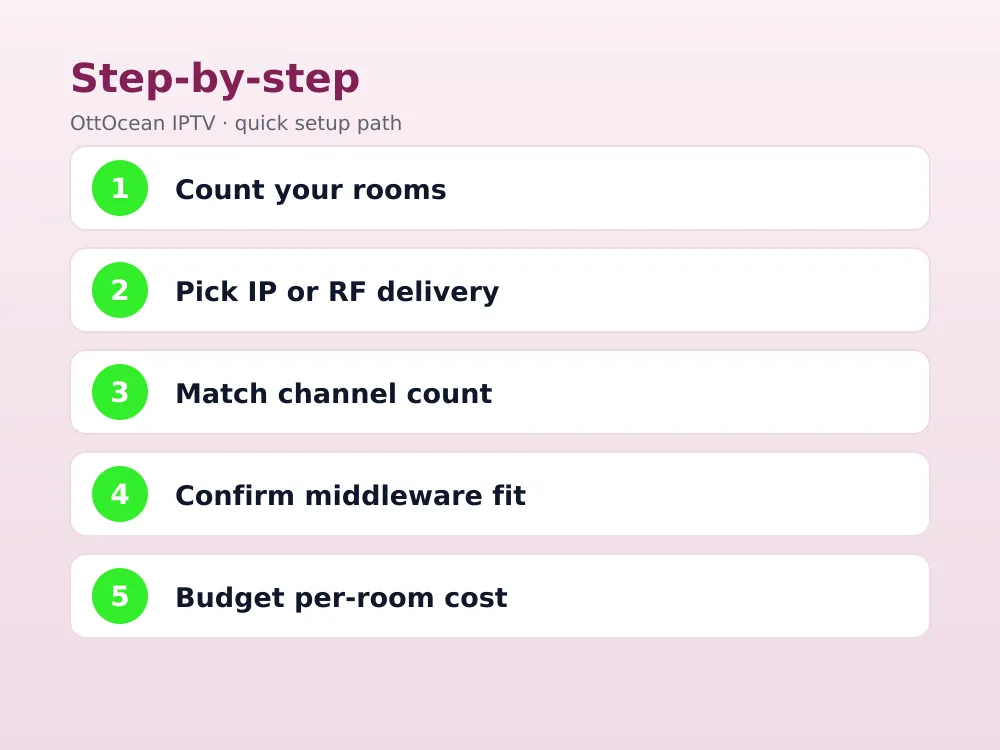
Room count is the single biggest factor in choosing a hotel iptv encoder. A boutique property under 100 rooms can often run on a single 4-8 channel encoder with room for growth. Mid-size hotels between 150 and 400 rooms typically need a dedicated hospitality headend system with dozens of channel slots and redundant hardware.
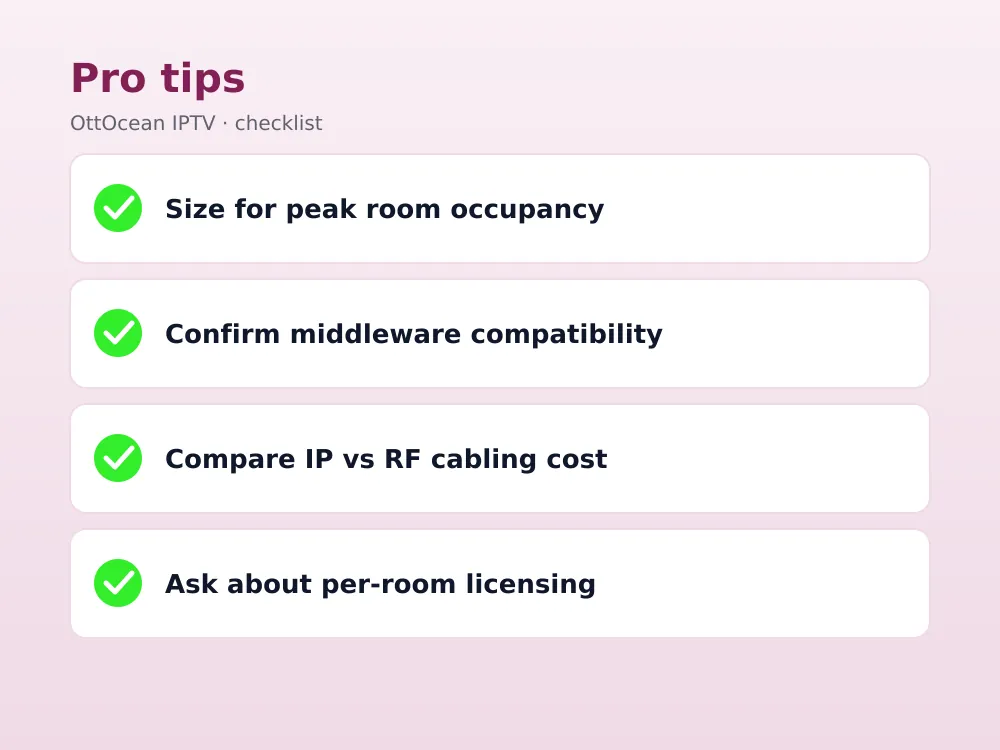
Occupancy patterns matter too, not just total room count. A property that regularly runs near full occupancy during peak season should size slightly above its baseline room count, since a headend struggling during your busiest weeks of the year is worse than one with modest spare capacity the rest of the time and year-round.
Large resorts and convention hotels above 400 rooms usually need enterprise-grade platforms like Exterity or Tripleplay, which support thousands of endpoints, multiple properties under one management system, and features like pay-per-view and in-room casting that smaller systems don’t offer.
For readers comparing encoder hardware more broadly beyond the hospitality-specific systems here, our complete IPTV encoder buying guide covers non-hospitality tiers, which is useful context if your property is also running a smaller side project like a staff lounge feed or a single conference room display that doesn’t need full headend infrastructure.
The 7 Best Hotel IPTV Encoders for Hospitality in 2026
These seven systems cover the range from boutique properties to full-scale resort deployments, based on published specs and hospitality integrator documentation.
1. URayCoder 8-Channel Hospitality Encoder
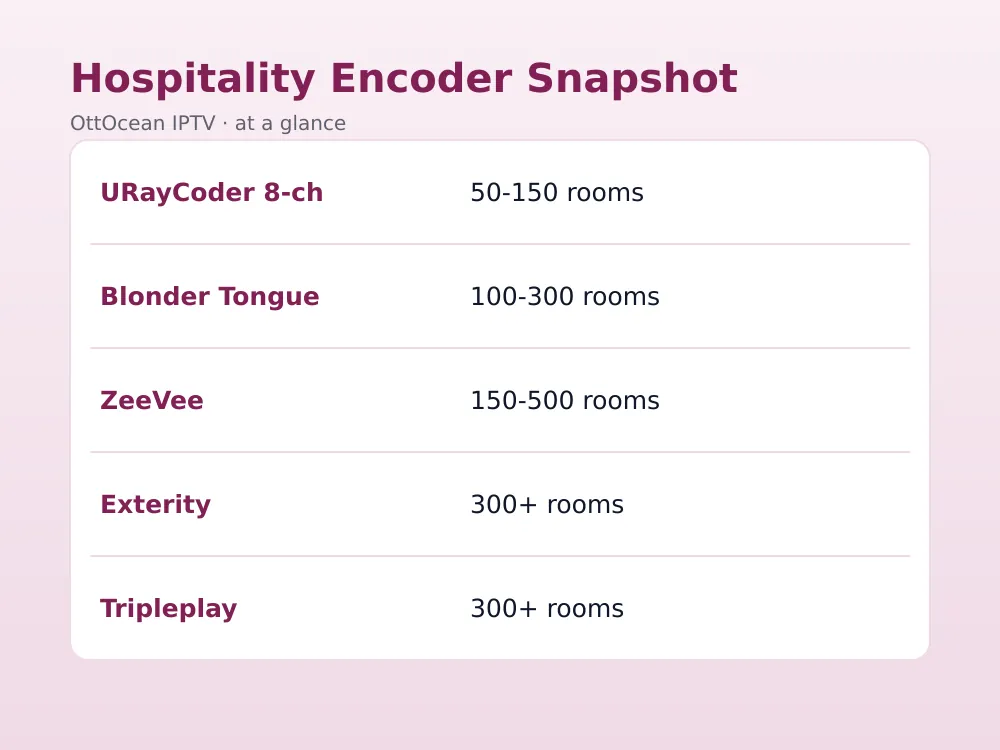
URayCoder’s 8-channel unit is the most affordable genuine hotel iptv encoder on this list, capable of encoding up to 8 simultaneous channels for IP multicast distribution to roughly 50-150 rooms depending on channel lineup and bandwidth. It’s a strong fit for independent boutique hotels and small inns.
It lacks the enterprise middleware integrations of pricier systems, so guests get standard channel surfing rather than interactive hotel information or casting features, which is a reasonable tradeoff for smaller properties on a tighter budget. Setup typically takes an AV integrator one to two days for a property this size.
2. Blonder Tongue RF/IP Headend
Blonder Tongue has decades of hospitality broadcast experience and offers both RF modulation and IP encoding in the same product family, making it a practical choice for a property transitioning from legacy coax to IP over time. It suits 100-300 room properties well.
Their modular chassis design lets a property add channel capacity incrementally rather than replacing the whole headend at once, which spreads capital cost over several budget cycles. This staged approach tends to appeal to independently owned properties without a large annual capital improvement budget for AV infrastructure, letting owners spread costs across multiple fiscal years instead of one large upfront purchase.
3. ZeeVee IP Multicast System
ZeeVee focuses specifically on IP-based AV distribution, and their hospitality line is built around simple middleware integration and guest-facing channel branding that hotels can customize with their own welcome screens. It’s our top overall recommendation for mid-size properties in the 150-500 room range moving to a modern multi-channel hotel distribution setup.
Installation typically requires a certified ZeeVee integrator, which adds upfront cost but generally results in a more reliable rollout than a self-installed system for a property this size. Guest feedback on channel switching speed and picture quality has generally been strong across documented hospitality deployments.
4. Exterity Enterprise IPTV Platform
Exterity is built for large-scale hospitality and enterprise AV deployments, supporting thousands of endpoints, multi-property management, and advanced features like digital signage integration alongside standard guest room channels. It’s overkill for a small property but genuinely necessary for large resorts and convention hotels.
Their platform also supports centralized management across multiple hotel properties under one brand, which matters for chains standardizing their in-room entertainment experience across locations. Expect a notably longer sales and implementation cycle than the smaller systems on this list, often several full months from contract signing to complete deployment.
5. Tripleplay Hospitality Suite
Tripleplay’s hospitality-specific platform bundles IPTV distribution with digital signage, room casting, and guest engagement tools into one system, aimed at full-service resorts that want more than just channel surfing in the guest room experience.
It’s a bigger investment than a pure encoding system, but for a property that wants to differentiate its guest room technology experience, the bundled feature set can justify the added cost over a bare-bones hotel iptv encoder. Resort and convention properties tend to get the most value from Tripleplay’s signage and engagement tools.
6. VeCOAX Compact Headend
VeCOAX makes compact, rack-mount encoding and modulation hardware aimed at small to mid-size hospitality and healthcare deployments. Their systems support both IP and RF output from the same chassis, which is useful for a property running a mixed legacy-and-modern room base.
It’s a solid middle-ground option between the budget URayCoder unit and the full enterprise platforms, suited to independent hotels in the 100-250 room range who want professional reliability without enterprise pricing. Its compact form factor also fits smaller equipment closets common in older converted properties and historic building conversions.
7. Exterity Alternative: Vecima/Minerva Hospitality Line
For hotels already working with a cable or telecom-adjacent vendor, hospitality-focused product lines from companies like Vecima offer similar enterprise capability to Exterity with potentially better integration if the property already uses related infrastructure. Worth a comparison quote for larger properties.
These systems generally require the same level of professional installation and ongoing support contract as Exterity or Tripleplay, so factor that into total cost of ownership rather than comparing headend hardware price alone. Request references from other hospitality properties of similar size and region before signing a multi-year contract with any enterprise vendor in this category.
Hotel IPTV Encoder Comparison Table
| System | Delivery | Best Room Range | Notes |
|---|---|---|---|
| URayCoder 8-ch | IP multicast | 50-150 | Most affordable entry point |
| Blonder Tongue | RF/IP | 100-300 | Good for RF-to-IP transition |
| VeCOAX | RF/IP | 100-250 | Compact, mixed legacy support |
| ZeeVee | IP multicast | 150-500 | Best overall mid-size pick |
| Vecima/Minerva | IP multicast | 300+ | Telecom-adjacent integration |
| Exterity | IP multicast | 400+ | Multi-property enterprise management |
| Tripleplay | IP multicast | 400+ | Bundled signage and guest engagement |
Middleware and Guest Experience Considerations
The headend hardware is only half the picture. Middleware controls what guests actually see: the channel guide, hotel information screens, casting options like Chromecast or AirPlay, and any pay-per-view or premium content. A hospitality headend system with weak middleware frustrates guests even if the underlying video quality is perfect.
Ask any vendor for a live demo of the actual guest-facing interface, not just the backend management dashboard, since that’s what determines guest satisfaction scores and, in many properties, directly affects review mentions of the in-room TV experience.
A well-configured hotel iptv encoder paired with weak middleware is one of the most common gaps we see in hospitality reviews online. Guests rarely comment on encoding quality directly, but they absolutely notice a slow, confusing channel guide or a casting feature that doesn’t reliably connect.
Cost Per Room: What to Actually Budget
Cost per room varies enormously by system tier. Budget systems like the URayCoder 8-channel option can land under $50 per room for headend hardware alone on a 100-room property, while full enterprise platforms like Exterity or Tripleplay often run $150-400 per room once installation, middleware licensing, and support contracts are included.
Always request a total cost of ownership quote covering the first three years, not just headend hardware, since licensing and support fees on enterprise multi-channel hotel distribution systems often exceed the original hardware cost over that period. Ask specifically whether support and firmware updates are included or billed separately after the first year.
Common Mistakes When Choosing Hospitality Encoders
The most common mistake is sizing for current room count instead of planned expansion. A property adding a new wing in two years should choose a system with headroom now rather than replacing the entire headend later, since hospitality installations are disruptive to guest operations.
The second mistake is underestimating installation complexity. A hotel iptv encoder deployment touches every guest room’s TV wiring, which means real coordination with housekeeping and front desk operations during installation, not just a simple equipment swap in a back room. Schedule installation floor by floor during low-occupancy periods to minimize guest disruption.
The third mistake is ignoring ongoing licensing costs when comparing quotes. Some hospitality headend system vendors charge per-room annual licensing on top of the hardware, which can meaningfully change the total cost ranking between two systems that look similar on paper.
Some hotels also explore reselling premium IPTV packages to guests as a revenue-generating amenity rather than just offering standard cable channels. If that’s on your radar, our IPTV reseller business guide covers the economics of that model separately from the hospitality headend decision covered here.
The fourth mistake worth flagging is choosing a vendor purely on price without checking their hospitality-specific track record. A vendor experienced in office or residential AV isn’t automatically equipped to handle the reliability and channel-lineup demands of a hotel iptv encoder deployment across hundreds of simultaneous guest rooms.
Key takeaways
- A hotel iptv encoder needs to reliably serve dozens of channels to potentially hundreds of rooms simultaneously
- IP multicast for hotels is the modern standard, though RF modulation remains practical for legacy coax wiring
- ZeeVee offers the strongest overall value for mid-size properties in the 150-500 room range
- Room count and planned expansion should drive sizing decisions, not just current occupancy
- Middleware quality matters as much as headend hardware for actual guest satisfaction
- Always budget total cost of ownership, including licensing, not just headend hardware price
FAQ: hotel iptv encoder
What’s the best hotel iptv encoder for a small independent hotel?
For properties under 150 rooms, the URayCoder 8-channel encoder or VeCOAX compact headend offer the best value, providing genuine hospitality-grade reliability without enterprise pricing or the complexity of a full middleware platform.
Should I choose IP multicast for hotels or stick with RF modulation?
If you’re renovating or building new, IP multicast is the better long-term choice for flexibility and future feature support. If your property already has solid coax wiring and doesn’t need advanced interactive features, RF modulation remains a practical, lower-cost option.
How many channels does a typical hospitality headend system need?
Most hotels offer between 40 and 100 channels, though premium and international properties often go higher. Confirm your encoder or headend system’s channel capacity comfortably exceeds your planned lineup, with room for adding channels later without a hardware upgrade.
What does a multi-channel hotel distribution system typically cost per room?
Budget systems can run under $50 per room for hardware alone, while full enterprise platforms with middleware and support contracts often reach $150-400 per room over a multi-year term. Always compare total cost of ownership, not just headend price.
Do I need a professional installer for a hotel iptv encoder deployment?
For anything beyond a small boutique property, yes. Hospitality deployments involve wiring to every guest room and integration with existing network or coax infrastructure, which is specialized work best handled by a certified AV integrator familiar with the specific system.
Can a hotel iptv encoder support guest casting features like Chromecast?
Higher-tier systems like ZeeVee, Exterity, and Tripleplay support casting and interactive guest features through their middleware. Budget encoders like the URayCoder 8-channel unit typically only handle standard channel distribution without casting support.
Final Verdict
For most mid-size hotels, ZeeVee’s IP multicast system is the smartest hotel iptv encoder investment in 2026, balancing scalability, middleware quality, and reasonable cost per room. Smaller properties should start with the URayCoder 8-channel unit, while large resorts need Exterity or Tripleplay’s full platform. Whichever tier fits your property, get a written total cost of ownership quote before signing.
If your property is exploring in-room IPTV as a guest amenity rather than building a full hospitality headend, a ready-made subscription service is worth considering for common areas or staff use; check OttOcean’s subscription plans or the free 5-day trial, no credit card required, before committing capital budget to a full hospitality-grade headend rollout across every guest room floor. For background on IP multicast technology referenced throughout this guide, see the Wikipedia entry on IP multicast.